
Seir means Jesus? - An exercise in Muslim Geography
Al-Kadhi claims in section 6.10 that "Seir is a reference to Jesus." This is not a new suggestion. Yaqut made this association of Seir with Jesus already in the early 13th century when his entry on Faran contains the interpretation that "and dawned from Saa`iir [Seir]" refers to "His sending down of the Injiil upon Isa".
However, al-Kadhi might have realized that Yaqut did not give any factual evidence for this opinion. Therefore he tries to do better and ends up doing worse. Having a wrong opinion is one thing, ascribing one's own false statements to a Bible dictionary is another. Let us examine how al-Kadhi constructs his claims:
Seir is a reference to Jesus (pbuh). It is usually associated with the chain of mountains West and South of the Dead Sea extending through Jerusalem, and Bethlehem, the birthplace of Jesus (pbuh). It was later extended to include the mountains on the East side as well (Dictionary of the Bible, John L. McKenzie, S.J., p. 783).
Al-Kadhi's does not indicate very clearly what is his personal opinion and which statement is the quotation from John McKenzie's Dictionary of the Bible. In the following we give the complete citation:
Seir (Hb se'ir), a geographical name; Seir is associated with Esau and Edom and the association is expressed on a play on the words se'ar, "goat," and sa'ir, "hairy," in Gn 25:25He that came forth first was red, and hairy like a skin: and his name was called Esau. Immediately the other coming forth, held his brother's foot in his hand: and therefore he was called Jacob.; 27:11, 23. The name appears as a designation of a land, of a mountain, and as a gentilic. There is no doubt that the mountain is the chain which extends SW of the Dead Sea along the W side of the Arabah, rising to an average height of 5000 ft. The name was later extended to the corresponding mountain chain on the E side of the Arabah. As a territorial designation of the term it is used more loosely of the region adjacent to the mountain chain, substantially identical with the territory of Edom. In tradition the Horites were the pre-Edomite inhabitants of the region (Gn 14:6And the Chorreans in the mountains of Seir, even to the plains of Pharan, which is in the wilderness.; 36:30). The eponymous ancestor Seir the Horite (Gn 36:20These are the sons of Seir, the Horrite, the inhabitants of the land: Lotan, and Sobal, and Sebeon, and Ana,f; 1 Ch 1:38The sons of Seir: Lotan, Sobal, Sebeon, Ana, Dison, Eser, Disan.) is a good example of the personification of a geographical name into the ancestor of the clans who dwell there. Israelite tradition itself recognized that the claim of Edom to Seir and its settlement there were older than its own claim to Canaan. It was the region of Esau the brother of Jacob (Gn 32:4And he commanded them, saying: Thus shall ye speak to my lord Esau: Thus saith thy brother Jacob: I have sojourned with Laban, and have been with him until this day:; 33:14,16; 36:8f; Nm 24:18And he shall possess Idumea: the inheritance of Seir shall come to their enemies, but Israel shall do manfully.; Dt 2:4And command thou the people, saying: You shall pass by the borders of your brethren the children of Esau, who dwell in Seir, and they will be afraid of you.ff; Jos 24:4And gave him Isaac: and to him again I gave Jacob and Esau. And I gave to Esau mount Seir for his possession: but Jacob and his children went down into Egypt.). Dt 1:44And the Amorrhite that dwelt in the mountains coming out, and meeting you, chased you, as bees do: and made slaughter of you from Seir as far as Horma. places the land of Seir S of the hill country of the Amorites beginning in the neighborhood of Hormah, which is not itself precisely located. It lay between Horeb and Kadesh-barnea (Dt 1:2Eleven days' journey from Horeb by the way of mount Seir to Cadesbarne.); this tradition is some help in locating these two points. The Israelites passed around Mt Seir to the S to avoid encroaching on Edomite territory (Dt 2:1-5And departing from thence we came into the wilderness that leadeth to the Red Sea, as the Lord had spoken to me: and we compassed mount Seir a long time.). An isolated traditon in 1 Ch 4:42Some also of the children of Simeon, five hundred men, went into mount Seir, having for their captains Phaltias and Naaria and Raphaia and Oziel the sons of Jesi: relates that the clans of Simeon settled in Mt Seir. The mountain becomes a loose designation of its inhabitants as "the men of Seir or Mt Seir" (2 Ch 20:10, 22Now therefore behold the children of Ammon, and of Moab, and mount Seir, through whose lands thou didst not allow Israel to pass, when they came out of Egypt, but they turned aside from them, and slew them not,f; 25:11, 14); these must be the Edomites. Ezk 35 contains an oracle against Mt Seir (contrasted with the mountains of Israel, which are blessed in 36), alluding to the plundering of Judahite territory by Edom after the fall of Jerusalem in 587 BC. Yahweh twice comes from Seir in a theophany (Dt 33:2And he said: The Lord came from Sinai, and from Seir he rose up to us: he hath appeared from mount Pharan, and with him thousands of saints. In his right hand a fiery law.; Jgs 5:4O Lord, when thou wentest out of Seir, and passedst by the regions of Edom, the earth trembled, and the heavens and clouds dropped water.); this probably means merely the S, the region of the theophanies of Sinai and Kadesh-barnea. It is probable that the name first belonged to the mountain and was extended to the region. The frequent use of the name indicates that it was a much older designation of the region than the settlement of Edom." (John L. McKenzie, S.J., Dictionary of the Bible, pp. 783-784)
Let us now take al-Kadhi's statements piece by piece, and see if they in any way are backed up by his claimed reference.
"Seir is a reference to Jesus (pbuh)" is clearly not found in the above dictionary entry. It is al-Kadhi's hypothesis which he seeks to support. For this purpose he claims,
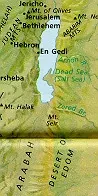
It is usually associated with the chain of mountains West and South of the Dead Sea extending through Jerusalem, and Bethlehem, the birthplace of Jesus (pbuh).
This is a clear misrepresentation of the dictionary entry, which states:
There is no doubt that the mountain is the chain which extends SW of the Dead Sea along the W side of the Arabah ...
This image from a Biblical geography map clearly shows that the Arabah is only to the South of the Dead Sea. So, according to McKenzie this mountain range extends from the South West corner of the Dead Sea towards the South not to the North up to Jerusalem as al-Kadhi claims. Nowhere does McKenzie suggest that Seir extends along the West side of the Dead Sea.
It was later extended to include the mountains on the East side as well (Dictionary of the Bible, John L. McKenzie, S.J., p. 783).
The above later sentence is the only part which has some similarity to the claimed reference which reads,
The name was later extended to the corresponding mountain chain on the E side of the Arabah. As a territorial designation of the term it is used more loosely of the region adjacent to the mountain chain, substantially identical with the territory of Edom.
Al-Kadhi seems to think that wresting some words from one sentence in a dictionary is enough to legitimately cite this dictionary as an authentication for his claims. It is obvious that he is deliberately distorting this quotation. In the dictionary we read that the name is extended to the mountains on the East side of the Arabah. In the way Al-Kadhi arranges the words, he makes it to mean the mountains on the East side of the Dead Sea. This is completely wrong. Although his remark about the East side is irrelevant for his own hypothesis which seeks to connect Seir with Bethlehem (located North West of the Dead Sea), it is included to be able to claim McKenzie as a reference, since these are the only words taken from this dictionary. The very next statement by McKenzie makes this situation even worse for al-Kadhi, because it unambiguously states that Seir is "substantially identical with the territory of Edom." Edom never included Bethlehm or Jerusalem. We leave it to the reader to evaluate the intellectual integrity of al-Kadhi's approach to quoting sources.
Interestingly, careful attention to McKenzie's dictionary entry exposes in al-Kadhi's above paragraph not only a geographical misquotation but also an exegetical error.
Al-Kadhi was not done with his discussion of Seir after the quotation we have discussed abpve. He brings further "witnesses":
However, Seir is also identified with the Northern border of the tribal territory of Judah and usually with Saris near Kesla (Chesalon), barely nine miles West of these two cities (The Eerdmans Bible Dictionary, by Allen C. Myers, pp. 921-922, and The Interpreter's Dictionary of the Bible, V4, p. 262)
This is yet again a misquotation, since the text in The Eerdmans Bible Dictionary states:
1. Mt. Seir, the central mountain range of Edom, [...] Seir rises steeply from the eastern side of the Arabah from the Gulf of Aqabah in the south to the Wâdi el-Hesa (Zered), southeast of the Dead Sea, in the north. [...] Because of [...], some scholars suggest that Seir could also designate an area on the western side of the Arabah across from Seir proper (cf. Num. 20:23Where the Lord spoke to Moses:; Deut. 1:44And the Amorrhite that dwelt in the mountains coming out, and meeting you, chased you, as bees do: and made slaughter of you from Seir as far as Horma.).
2. A mountain on the northern border of the tribal territory of Judah (Josh. 15:10And it compasseth from Baala westward unto mount Seir: and passeth by the side of mount Jarim to the north into Cheslon: and goeth down into Bethsames, and passeth into Thamna.; possibly mentioned at Deut. 1:44And the Amorrhite that dwelt in the mountains coming out, and meeting you, chased you, as bees do: and made slaughter of you from Seir as far as Horma.; 1 Chr. 4:42Some also of the children of Simeon, five hundred men, went into mount Seir, having for their captains Phaltias and Naaria and Raphaia and Oziel the sons of Jesi:). It is usually identified with modern Saris, ca. 4 km. (2.5 mi.) southwest of Kiriath-jearim and 14.5 km. (9 mi.) west of Jerusalem.
Overlooking the statements in the main entry, al-Kadhi this time picked out a few words from 2. for the purpose of misquotation. Myers statement "A mountain on the northern border of the tribal territory of Judah" is transformed by him into "Seir is also identified with the Northern border of the tribal territory of Judah" in the obvious attempt to enlarge the extent of this mountain and hence the impact for the argument of identifying it somehow with Bethlehem.
Even though he does not say so explicitly, the way al-Kadhi arranges the flow of his argument formulating
Seir ... is usually associated with the chain of mountains West and South of the Dead Sea extending through Jerusalem, and Bethlehem, the birthplace of Jesus ... Seir is also identified with the Northern border of the tribal territory of Judah and usually with Saris near Kesla (Chesalon), barely nine miles West of these two cities. (emphasis ours)
he clearly wants to create the impression in the mind of the reader that Seir extends from south of Bethlehem to north of Bethlehem and, by implication, everything in between. In particular, Bethlehem is therefore supposedly part of Seir. This is blatantly wrong and al-Kadhi knows this, since he has read at least the dictionary entries of McKenzie and Myers which unambiguously state that Seir is on the territory of Edom not Judah. The fact that there is another mountain with the same name does hardly justify to connect the two and claim everything in between is Seir, too. This fallacy to just identify two different locations with the same name seems to be a favorite of al-Kadhi and has been discussed already for the case of Paran (see section 6.4: *, *).
It is obvious why al-Khadi did not quote the first entry of Myers instead of McKenzie as his main source on Seir. Myers would not even allow him to go anywhere East of the Dead See which he so much desired. As an aside, Myers also points out that McKenzie's position that Seir is east of the Arabah is only held by some scholars and Seir proper is southeast of the Dead Sea. However, both agree that it is the territory of Edom which destroys al-Kadhi's case.
I have not seen the entry in The Interpreter's Dictionary of the Bible, but given the above information and al-Kadhi's track record of quoting so far, there is little hope that it will say anything else but confirm the other dictionaries and refute Al-Kadhi's concocted theories.
More examples of al-Kadhi's citation problems
The Rebuttal to "What Did Jesus Really Say?"
Answering Islam Home Page