
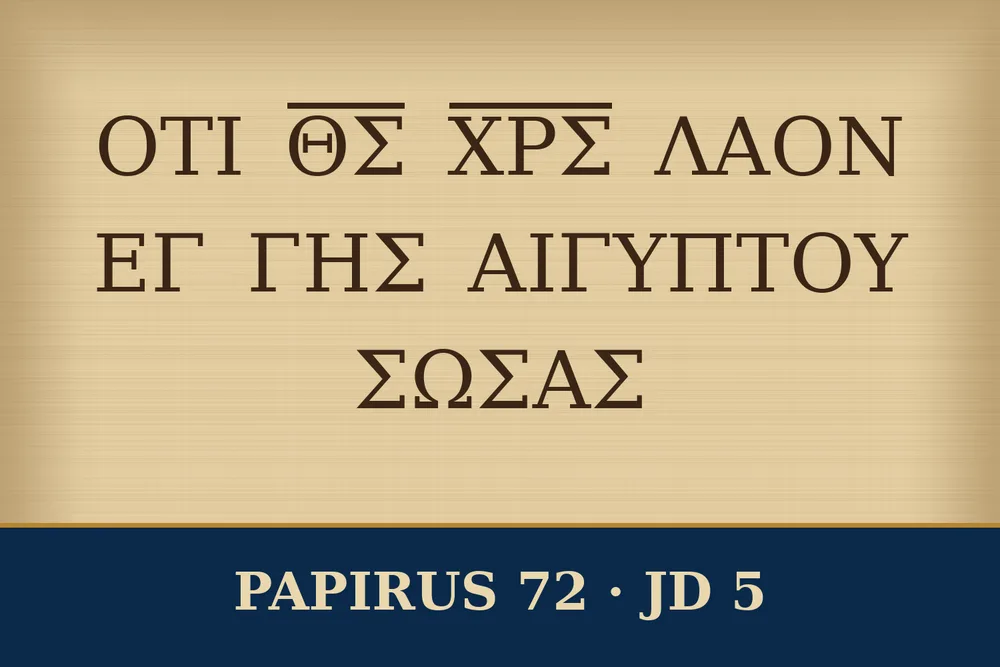
In Egypt, at the end of the third or the beginning of the fourth century, a Christian was copying the Letter of Jude. When he came to the fifth verse, where the Exodus from Egypt is mentioned, he wrote: “God Christ saved a people out of the land of Egypt”.
The One who parted the sea, fed Israel with manna in the wilderness, and gave them the Law on Sinai, is for him Christ. And that Christ is God.
We call that copy Papyrus 72 today. It is the oldest known copy of the First and Second Letter of Peter and the Letter of Jude, written when persecution had not yet ceased and before the Church had gathered in any general council. We have placed it word for word alongside the Greek text from which these epistles are translated today, and it bears witness that the Church from the beginning professed what the apostles wrote: Jesus Christ is Yahweh, the God of Israel, who became man.
A Scribe's Little Book
Papyrus 72 was part of a small codex into which the owner gathered what was dear to him: the account of the Nativity of the Blessed Virgin Mary, the Paschal homily of Melito of Sardis, two psalms, a hymn, the defense of the martyr Phileas, and, among them, the Letters of Peter and Jude. All three epistles were copied by the same hand.
The codex was purchased in the mid-twentieth century by the Swiss collector Martin Bodmer, and in 1969 he presented the Epistles of Peter to the Vatican Apostolic Library, where they are preserved today. The Epistle of Jude remained at the Bodmer Foundation in Cologny near Geneva. Both institutions photographed the manuscript and made it available online, so that anyone can examine it page by page.
Yahweh Is Jesus
In the Old Testament, God reveals his name: Yahweh. The Greek translation of the Old Testament, which the apostles read and quoted, translates that name with the word Kyrios, Lord. When an apostle takes a verse in which a prophet or a psalm speaks of Yahweh and applies it to Jesus, he is thereby stating that Jesus is Yahweh. Papyrus 72 has several such passages, and in two of them the scribe says this even more clearly than today's text.
Yahweh who brought Israel out of Egypt. On Sinai God speaks: “I am the LORD your God, who brought you out of the land of Egypt, out of the house of bondage.” (Exod 20:2) Jude in the fifth verse writes of the same deliverance: “Now I desire to remind you, though you already know this, that the Lord, having saved a people out of the land of Egypt, afterward destroyed those who didn’t believe.” (Jude 5) Manuscripts differ here: some have “Jesus”, others “Lord”. Papyrus 72 has: “God Christ saved a people out of the land of Egypt”. The One who revealed himself on Sinai as Yahweh is, for the scribe, Christ. Ivan Šarić in a note to this verse, in 1941, explains the same: Jude is referring precisely to Christ, the Angel of the Lord who led Israel.
Yahweh of the psalm. The psalm says: “Oh taste and see that the LORD is good. Blessed is the man who takes refuge in him.” (Ps 34:8) Peter quotes these words: “if indeed you have tasted that the Lord is gracious.” (1 Pet 2:3) and immediately continues: “Come to him, a living stone, rejected indeed by men, but chosen by God, precious.” (1 Pet 2:4) The Lord who is approached is, therefore, Christ. The scribe of Papyrus 72 says this directly: “if you have tasted, you have believed that Christ is Lord”. The Greek words for “kind” (chrestós) and “Christ” (Christós) were pronounced almost identically, and he wrote the holy name of Christ. The Lord of the psalm, Yahweh, is for him Christ.
Yahweh of hosts from Isaiah. The prophet Isaiah writes: “The LORD of Armies is who you must respect as holy. He is the one you must fear. He is the one you must dread.” (Isa 8:13) “He will be a sanctuary, but for both houses of Israel, he will be a stumbling stone and a rock that makes them fall. For the people of Jerusalem, he will be a trap and a snare.” (Isa 8:14) Peter applies both of these verses to Christ: “But sanctify the Lord God in your hearts. Always be ready to give an answer to everyone who asks you a reason concerning the hope that is in you, with humility and fear,” (1 Pet 3:15) and for those who do not believe Christ is “and, “a stumbling stone and a rock of offense.” For they stumble at the word, being disobedient, to which also they were appointed.” (1 Pet 2:8) Both passages in Papyrus 72 stand word for word as they do today. What the prophet says of Yahweh of hosts, the apostle says of Jesus.
The Day of Yahweh. The prophets announce the Day of Yahweh, the day when God comes to judge the world. Peter writes: “But the day of the Lord will come as a thief in the night, in which the heavens will pass away with a great noise, and the elements will be dissolved with fervent heat; and the earth and the works that are in it will be burned up.” (2 Pet 3:10) and invites us to wait for that day: “looking for and earnestly desiring the coming of the day of God, which will cause the burning heavens to be dissolved, and the elements will melt with fervent heat?” (2 Pet 3:12) For that coming he uses the same Greek word (parousía) with which he described the coming of Jesus Christ: “For we didn’t follow cunningly devised fables when we made known to you the power and coming of our Lord Jesus Christ, but we were eyewitnesses of his majesty.” (2 Pet 1:16) The Day of Yahweh is the day of Jesus' coming. And this stands in the papyrus just as it does today.
God and Savior
Alongside these passages, Papyrus 72 directly calls Jesus God.
2 Peter 1:1. Peter writes: “Simon Peter, a servant and apostle of Jesus Christ, to those who have obtained a like precious faith with us in the righteousness of our God and Savior, Jesus Christ:” (2 Pet 1:1) In Greek there is a single article before both words, “of our God and Savior”: God and Savior are one single person, Jesus Christ. Papyrus agrees here with today's text letter for letter.
2 Peter 1:2. Already in the next verse today's text reads: “Grace to you and peace be multiplied in the knowledge of God and of Jesus our Lord,” (2 Pet 1:2) Papyrus lacks the conjunction “and” between God and Jesus, and so reads: “in the knowledge of God Jesus, our Lord”.
1 Peter 5:1. “Therefore I exhort the elders among you, as a fellow elder and a witness of the sufferings of Christ, and who will also share in the glory that will be revealed:” (1 Pet 5:1) Where Peter mentions the sufferings of Christ, the scribe of Papyrus 72 writes: the sufferings of God. The One who suffered on the cross is for him God who suffered.
1 Peter 1:11. The prophets spoke through the Spirit of Christ: “searching for who or what kind of time the Spirit of Christ which was in them pointed to when he predicted the sufferings of Christ and the glories that would follow them.” (1 Pet 1:11) Christ was, therefore, before he was born of the Virgin, and his Spirit spoke through the prophets.
2 Peter 3:18. The epistle ends with praise addressed to Christ: “But grow in the grace and knowledge of our Lord and Savior Jesus Christ. To him be the glory both now and forever. Amen.” (2 Pet 3:18) The glory that belongs to God alone is given to Jesus.
The places where the papyrus agrees with today's text cannot be called a later addition by anyone, because they stand in the oldest copy we possess. And where it differs, it differs in such a way that it calls Christ God even more explicitly.
Sacred Names
The scribe wrote in capital letters, without spaces and without accents, as was the custom of the time. But a few words he did not write out in full, but abbreviated, with a line above them. These were the sacred names, and Christians throughout the world wrote them in this way out of reverence.
In Papyrus 72 that line is borne by the name God. The same line, in the same way, is borne by Jesus, Christ, and Lord. Before any council had defined anything, the hand of a Christian scribe placed the name of Jesus on the very same level as the name of God.
A Word Faithfully Preserved
In order to know how much trust can be placed in what the papyrus says about Christ, we compared every one of its words with today's text. The three epistles today contain 3,232 Greek words. Of those, there are in the papyrus:
-
2,970 words identical to today, 91.9 percent. Among them are 365 words that the scribe wrote as he pronounced them: the word is the same, only the spelling is different.
-
182 words with minor differences that change nothing: an article more or less, “and” instead of “but”, a word in a different place, another form of the same verb, an obvious scribal slip.
-
76 words with a slight nuance, such as “many trials” instead of “various trials”.
-
only 4 words that change the meaning, and those precisely in the places where the scribe calls Christ God.
In total, 97.5 percent of the text has no difference in meaning whatsoever. The scribe was a human being like us: in 65 places he noticed an error himself and corrected it, and in a few places his eye skipped a short piece of a line. Such slips are immediately noticeable, because what one scribe omits, thousands of other copies from Egypt, Syria, Asia Minor, Rome, and Gaul preserve.
Faith Before Nicaea
In the year 325, the Church gathered at Nicaea and solemnly professed that Jesus Christ is “God from God, Light from Light, true God from true God”. Papyrus 72 shows that this faith did not originate then. It was in the heart and in the pen of an ordinary Christian in Egypt before the bishops assembled, and it stands written in the apostolic letters that he was copying.
What he wrote, we still read today. Jesus Christ, our God and Savior, is the same yesterday, today, and forever.
Verse-by-Verse Comparison
We have placed every verse of Papyrus 72 alongside today's Greek text and alongside the Catholic translation of the Bible in your language. Every difference is marked with color and explained, so that even someone who does not know Greek can understand it.
Open the verse-by-verse comparison of Papyrus 72
Images of the manuscript itself: First and Second Peter, Vatican Apostolic Library · Jude, Bodmer Foundation
Transcription of Papyrus 72: Center for New Testament Restoration, CC BY-SA 4.0. Today's Greek text: CNTR Statistical Restoration, CC BY 4.0. Scripture quotations: World English Bible, Catholic Edition.